Published: 08 May 2026
The room fell unusually quiet when the first question was asked. How many people in the audience had recently read a full investigative report from beginning to end?
Inside the packed ballroom of the Bangladesh Journalism Conference 2026, only a handful of hands slowly went up. Moments later came a second question: how many had watched investigative journalism on television or online? This time, the room responded almost instantly.
That contrast was subtle but telling and quietly framed the central concern of the opening plenary at the Bangladesh Journalism Conference 2026, where Transparency International Bangladesh (TIB) joined as a Knowledge & Strategic Partner.
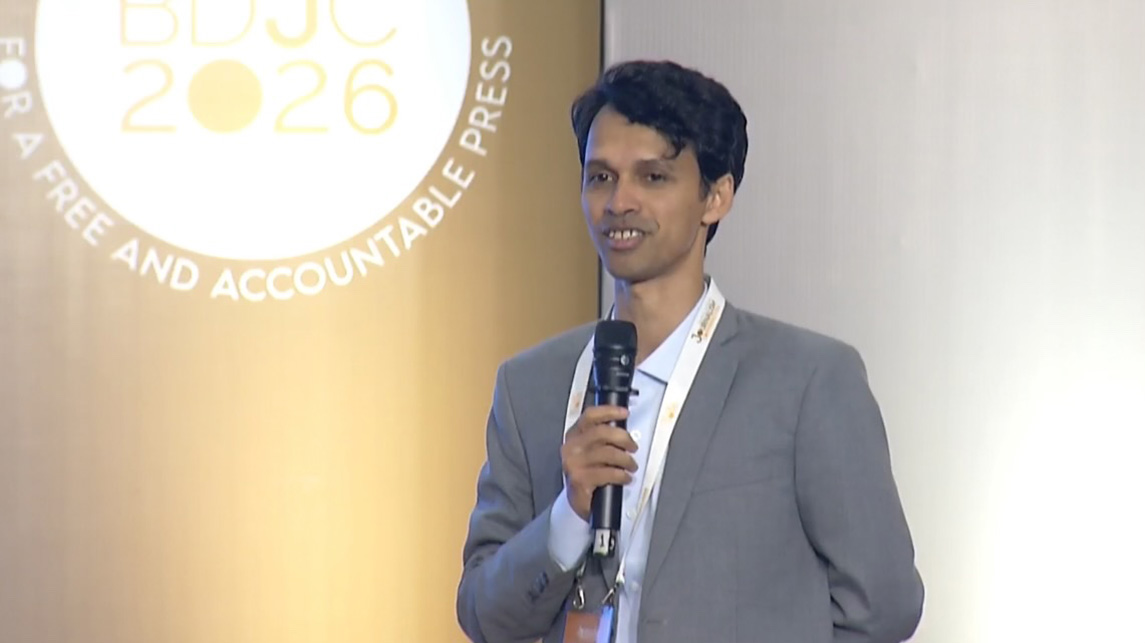
Delivering the keynote speech, Mohammad Tauhidul Islam, Director of Outreach and Communication at TIB, offered a blunt assessment of investigative journalism’s current reality in Bangladesh. “Truth-seeking has become one of the most expensive activities”, he remarked, stressing that investigative journalism today demands time, expertise, legal protection, data literacy, editorial commitment, and financial investment — resources many media houses are struggling to sustain amid shrinking revenues and relentless newsroom pressures.
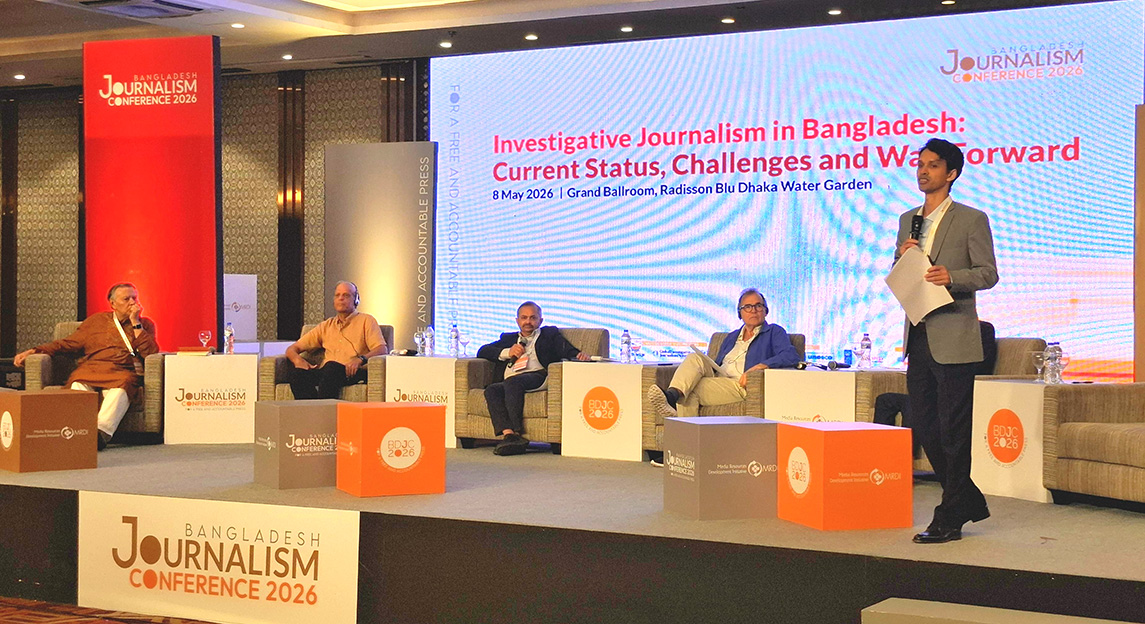
Mohammad Tauhidul Islam noted that investigations often require months of reporting, verification, legal review, and institutional backing, yet many are abandoned within weeks because newsrooms simply cannot afford the cost of pursuing them to completion. The discussion reinforced an urgent concern: if media institutions lose the ability to sustain investigative reporting, accountability journalism itself will gradually weaken.
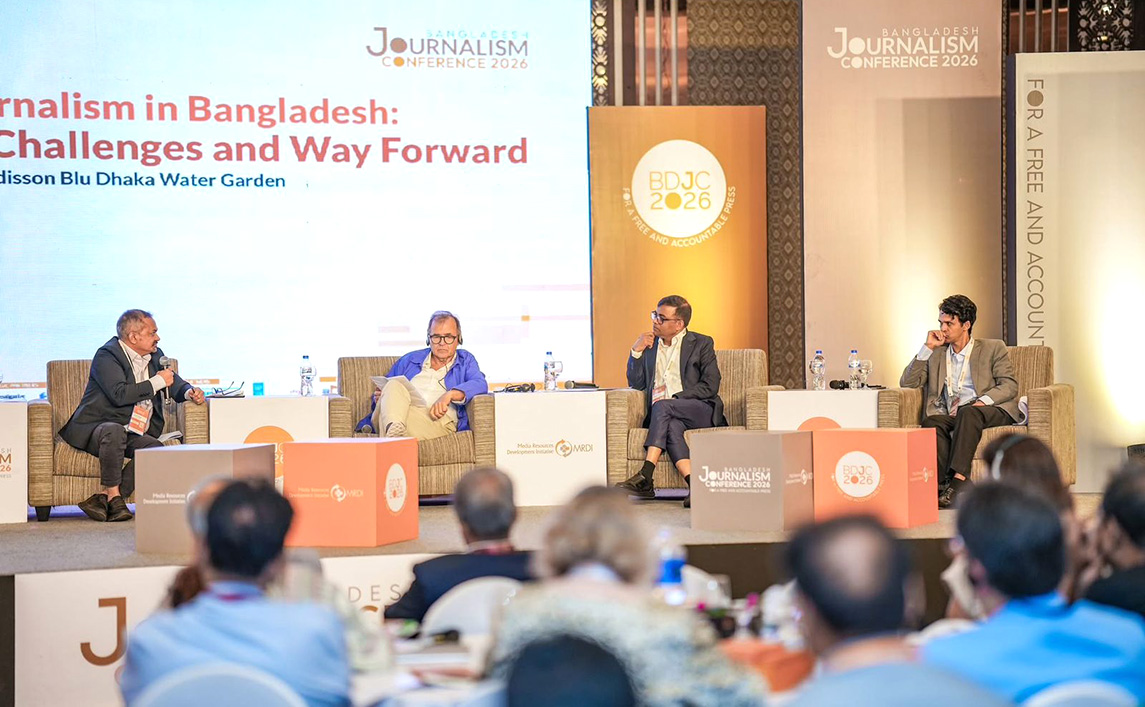
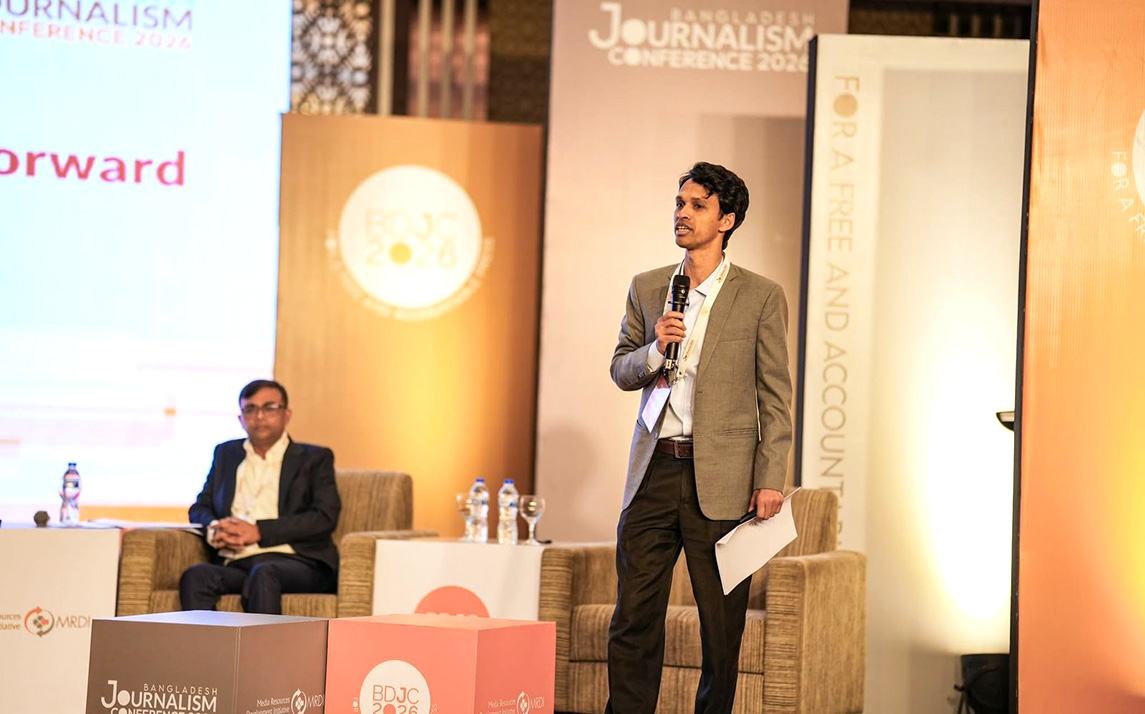
The first plenary session of the Bangladesh Journalism Conference, 2026, on May 08, 2026, moderated by Mr. Shakeel Anwar, former journalist at the BBC, brought together some of the region’s leading newsroom voices, including Mahfuz Anam, Editor and Publisher of The Daily Star; Michael Cooke, former Editor of the Toronto Star; Zaffar Abbas, Editor of Dawn; and Fahim Ahmed, Chief Executive Officer of Jamuna TV.
THE SHRINKING NEWSROOM, THE GROWING STORY
Reflecting on the Bangladesh context, Mahfuz Anam, Editor and Publisher of The Daily Star, observed that pressure inside newsrooms is rarely loud or direct. More often, it exists quietly within ownership structures, advertiser interests, political sensitivities, and institutional caution. In many cases, stories are not explicitly censored; they simply become too risky to pursue.

He also stated that investigative reporting is expensive by nature. It requires time, patience, specialized skills, legal safeguards, and editorial courage. Yet newsroom economics increasingly reward speed over depth. Journalists are expected to produce multiple stories daily, leaving little room for long-term investigations that may take months to verify and publish.
Michael Cooke, former Editor of the Toronto Star, drew parallels with the global decline of investigative reporting, noting that shrinking revenues and downsized newsrooms have weakened journalism worldwide. However, he emphasized that the crisis becomes far more severe when economic vulnerability intersects with political pressure. A newsroom struggling financially, he argued, becomes significantly more exposed to external influence and less capable of protecting editorial independence.
The discussion also returned to a central reality repeatedly emphasized by Mohammad Tauhidul Islam that investigative journalism cannot survive on editorial goodwill alone. Without sustainable institutional investment, newsroom protection, and long-term support for reporters, accountability journalism risks becoming increasingly unsustainable.

WHEN INVESTIGATIONS CREATED IMPACT
Despite the challenges, the plenary repeatedly returned to why investigative journalism still matters.
Fahim Ahmed, Chief Executive Officer of Jamuna TV, highlighted Jamuna TV’s investigation into irregularities within the LP gas sector, where sustained reporting on pricing manipulation and supply-chain practices generated administrative attention and broader policy discussion. The case stood as an example of journalism’s continuing ability to produce real public impact when institutions are willing to support difficult reporting.
The discussion made clear that investigative journalism is not merely about exposing corruption or wrongdoing for headlines. At its strongest, it directly affects public life—influencing governance, policy decisions, market accountability, and citizens’ everyday realities.
Speakers stressed that impactful investigations rarely happen accidentally. They require editorial commitment, institutional patience, and the willingness to withstand commercial or political discomfort. The fact that such conditions now feel exceptional, many noted, reveals how fragile the environment for investigative journalism has become.
A PROFESSION UNDER THREAT, A PRESS UNDER PRESSURE
The conversation also turned toward the growing risks journalists face across South Asia.
Zaffar Abbas, Editor of Dawn, reflected on how legal tools—including cybercrime legislation, defamation provisions, and prolonged legal proceedings—are increasingly used to intimidate journalists and pressure media institutions. The punishment, speakers argued, often lies not in conviction, but in the process itself: the investigations, court appearances, financial burden, and institutional exhaustion that follow.
Over time, such pressures create an atmosphere where journalists begin limiting themselves before anyone explicitly asks them to. Fear becomes internalized. Self-censorship gradually becomes a survival mechanism rather than an editorial decision.
Speakers also discussed how modern censorship no longer operates only through bans or direct suppression. In today's digital ecosystem, misinformation, coordinated counter-narratives, online harassment, and algorithm-driven distractions frequently drown out investigative reporting, quickly shifting public attention elsewhere.
A well-sourced investigation, panelists noted, can now disappear beneath forty-eight hours of manufactured outrage and digital noise without a single article being formally censored.
NOISE, DISTRACTION, AND THE SLOW SURRENDER OF TRUTH
Returning to the changing nature of information ecosystems, Mohammad Tauhidul Islam reflected on how truth today competes not only with secrecy but also with overwhelming volume.
The old model of censorship relied on silencing information. The newer model often works differently — flooding audiences with so much distraction, misinformation, and manufactured controversy that verified reporting struggles to survive public attention cycles.
Michael Cooke noted that digital platforms have fundamentally reshaped how journalism reaches audiences. Investigations may technically remain accessible, but algorithms increasingly determine whether they are meaningfully seen, shared, or remembered.
Mahfuz Anam added that in Bangladesh, serious investigative reports are frequently met with coordinated online attacks targeting the credibility of journalists rather than addressing the substance of the reporting itself. In such an environment, journalists are forced to defend both their reporting and their personal legitimacy simultaneously.
UNEQUIPPED AND UNDER PRESSURE
The plenary also acknowledged the profession’s own structural limitations.
The honorable discussants emphasized that modern investigative journalism now requires skills that many newsrooms still inadequately support, including financial forensics, data analysis, cybersecurity awareness, digital verification, and source protection. Without long-term investment in newsroom capacity and journalist training, many reporters will remain unequipped to investigate increasingly sophisticated forms of corruption and abuse of power.
Cross-border and collaborative journalism emerged as another major theme. Panelists stressed that partnerships between local and international newsrooms are becoming increasingly essential not only for sharing expertise and resources, but also for protecting investigations from being suppressed in any single jurisdiction.
The discussion further touched on the emotional toll of investigative reporting. Journalists working on corruption, violence, and abuse often carry prolonged psychological pressure, burnout, and professional isolation, yet newsroom conversations around mental well-being remain limited.
THE FUTURE OF TRUTH-TELLING
As the session drew to a close, one message became clear that investigative journalism in Bangladesh is surviving, but not without strain. The discussion made clear that Bangladesh does not lack stories worth investigating. What remains uncertain is whether the institutional courage, financial sustainability, and editorial independence necessary to pursue those stories can still be protected in the years ahead.
Ultimately, the future of investigative journalism may depend not only on the resilience of journalists themselves but also on whether media institutions, policymakers, and the public are willing to recognize independent journalism as more than a profession—as a democratic safeguard that cannot survive without collective commitment and protection.