Published: 29 April 2026
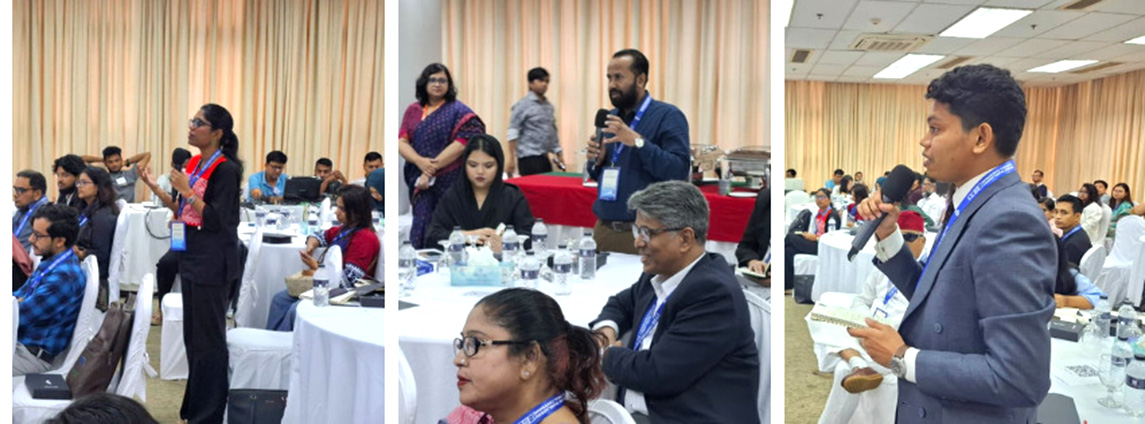
Someone in the audience asked a pointed question during the morning session: if the Digital Security Act has been repealed, why do journalists still feel afraid? Nobody on the panel disputed the premise. That, perhaps more than any statistic or legal argument, captured the mood at the Digital Rights Asia-Pacific (DRAPAC) Bangladesh National Convening 2026, held on 28 April at the Bangladesh-China Friendship Exhibition Centre in Dhaka.
As many speakers noted, the answer lies in the provisions that persist from one iteration to the next, not in any specific law. Between October 2018 and September 2024, more than 4,500 people faced repression under the DSA alone — politicians, journalists, media professionals, and civil society actors. People avoided carrying mobile phones to meetings. A climate of fear settled over public discourse. The law was not merely a legal text; it was a tool that reshaped how Bangladeshis thought, spoke, and moved through public life. When lawmakers finally repealed the law, they quietly carried forward many of its tools in the laws that replaced it.
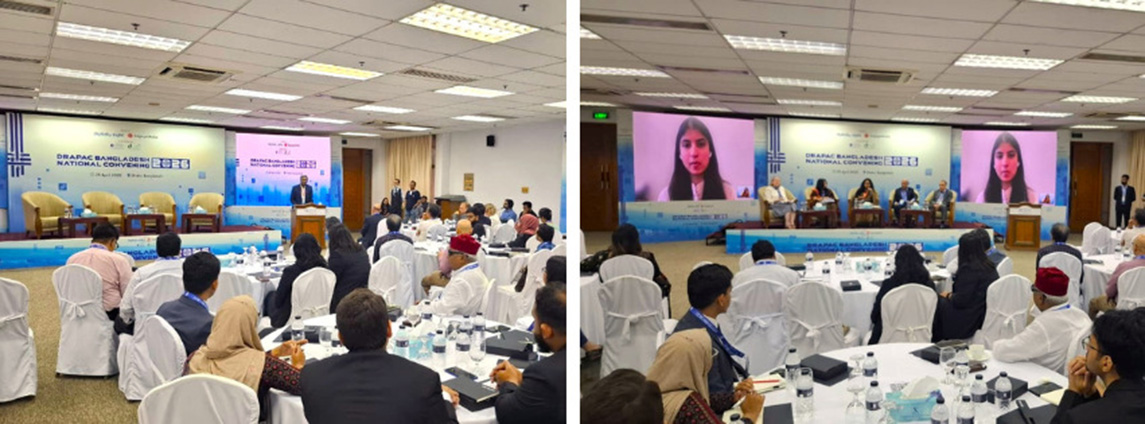
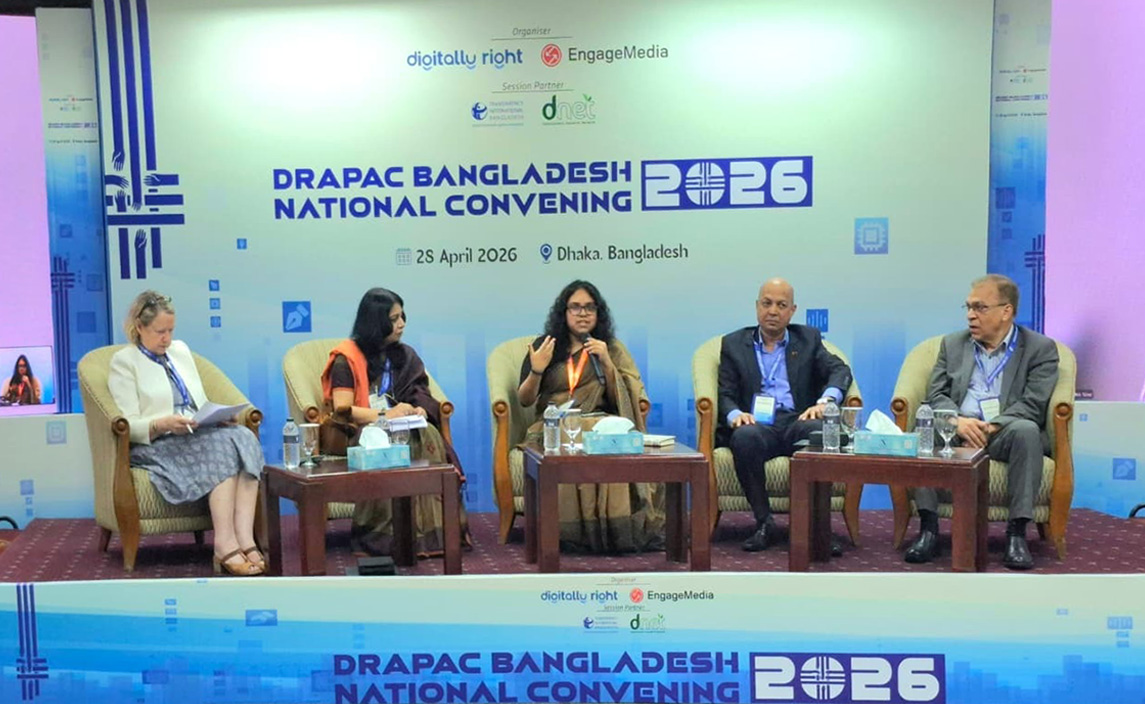
The DRAPAC Bangladesh National Convening 2026, organized by Digitally Right and EngageMedia with TIB and D-Net as session partners, was framed around a deceptively simple theme: 'Meaningful, Inclusive Lawmaking.' But the discussions that filled the Bangladesh-China Friendship Exhibition Center on 28 April told a harder story—that as Bangladesh's parliament passes a new generation of digital laws, the architecture of repression has simply been repackaged under different names, such as laws that apparently promote cyber-security but actually restrict freedom of expression and privacy.
The Same Architecture, Different Name
Dr. Iftekharuzzaman, the Executive Director of TIB, spoke candidly during the opening plenary. He argued that the Cyber Security Act, the Bangladesh Telecommunications Amendment Ordinance, the Personal Data Protection Ordinance, and the National Data Management Ordinance—all recently enacted—do not represent the clean break that the post-DSA moment demanded. “In reality, old laws have simply been reintroduced under new names, offering little support for people’s empowerment,” he said. “Ironically, many parliamentary leaders themselves suffered from the misuse of such laws in the past, yet they have enacted similar legislation again.”
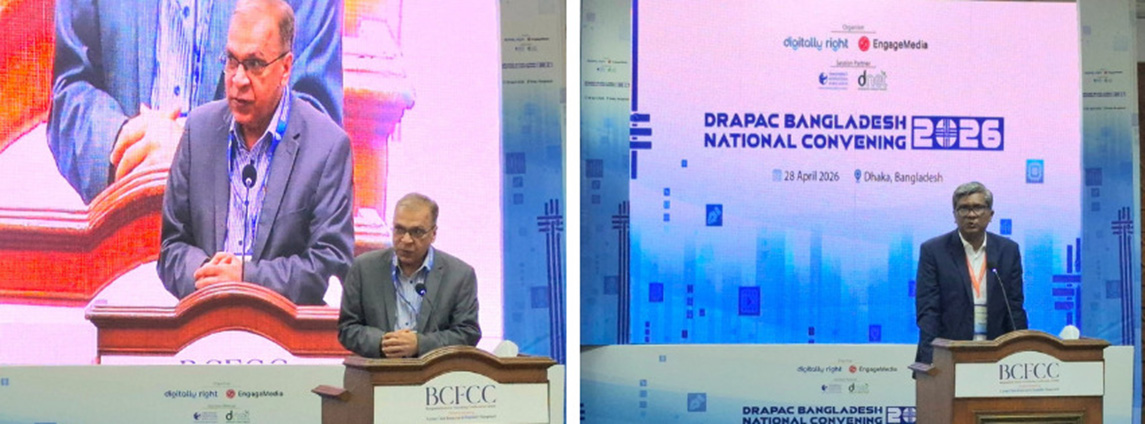
The sharpness of that irony is difficult to overstate. The lawmakers who now preside over Bangladesh’s digital legal framework are, often, the same people who once found themselves on the wrong end of it. And yet the new legislation retains clauses that grant authorities sweeping access to personal devices, preserves the infrastructure of digital surveillance, and was drafted without the kind of broad stakeholder consultation that meaningful reform requires. Dr. Iftekharuzzaman said that the inconsistencies contradict both the spirit of the July uprising and the electoral commitments made by the parties currently in parliament.
Aasha Mehreen Amin, Joint Editor of The Daily Star, gave the audience’s unease a sharper edge: cases are still being filed over Facebook posts, she observed, at a rate that has not meaningfully changed with the transition of government. Journalists face the same surveillance risks today as they did before. The law has changed; the chilling effect has not.
The Process Problem
Beneath the substance of the laws lies an equally serious problem of process. The interim government drafted this legislation without adequate stakeholder input. The elected government that followed pushed through amended versions with similar urgency. Each time, the earlier ordinances carried forward their deficiencies, further weakening the mechanisms designed to hold the government accountable. Bangladesh squandered its opportunity to create something truly unique on speed.
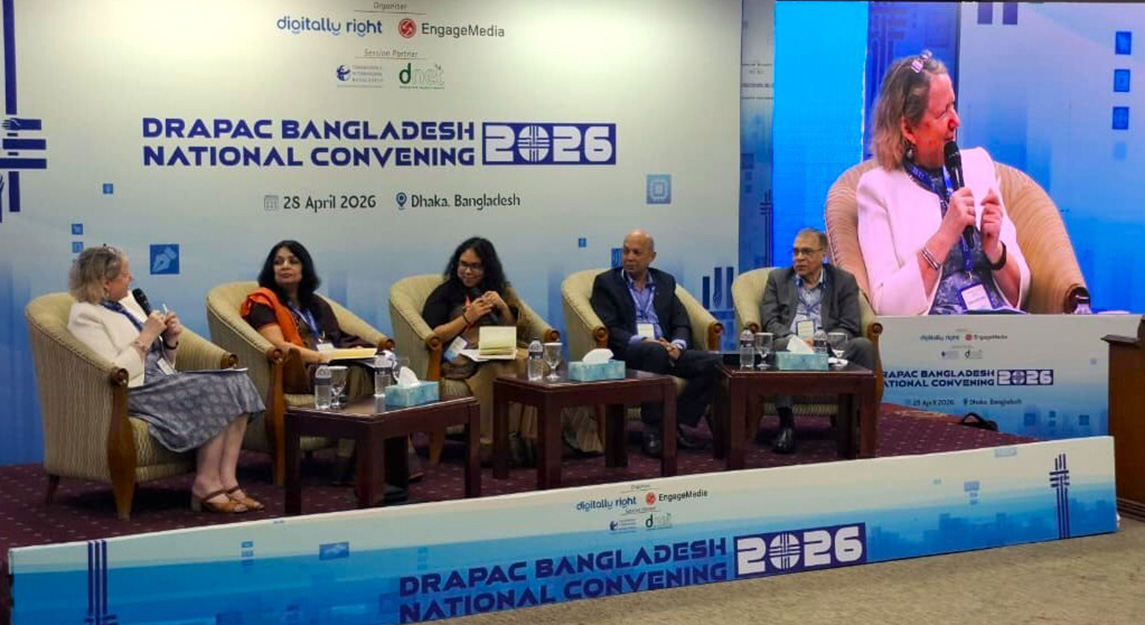
Susan Vize, UNESCO’s country representative to Bangladesh, urged the government to treat this juncture as a genuine opportunity—to bring these laws into alignment with international human rights standards through inclusive review before that window narrows further.
The government’s response illustrated how wide that gap remains. Muhammad Anwar Uddin, Additional Secretary of the Ministry of Posts, Telecommunications, and Information Technology, defended the laws as necessary and important, suggesting that any shortcomings could be addressed through later amendments. Civil society has often heard this familiar position, particularly during the years when the DSA was quietly accumulating its toll. Incremental correction is not the same as principled reform. Once lawmakers incorporate surveillance-enabling provisions into the architecture of a law from the outset, no amount of tinkering at the edges can eliminate them.
Industry, Inclusion, and the Limits of Dialogue
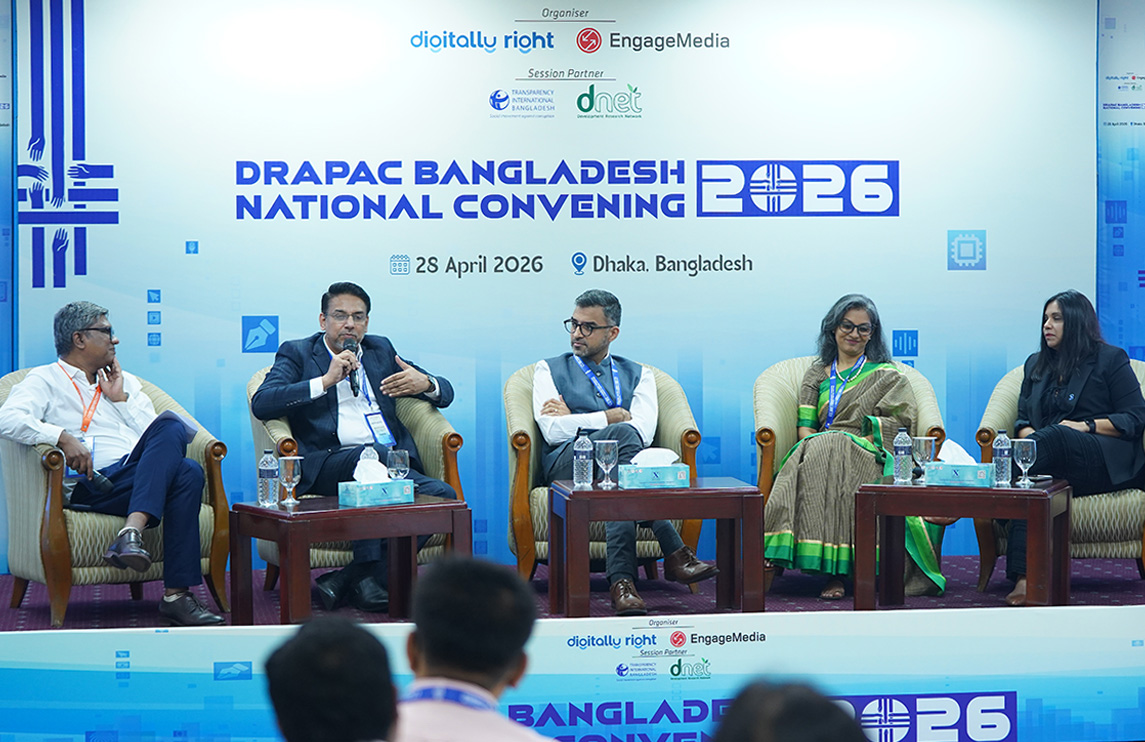
Later sessions broadened the lens. Representatives from Meta, Telenor Asia, and local startup ShareTrip, each from their own vantage points, have the same underlying concern: that the policy process excludes too many voices. Global platforms wrestle with data localization requirements that threaten their operations; telecoms seek clarity on a new regulatory body whose mandate, authority, and chain of command remain undefined; domestic startups find that the corridor to senior officials is simply not open to them in the way it is to larger players. The BTRC commissioner acknowledged the imbalance frankly—powerful groups reach policymakers more easily than others, and that asymmetry erodes public trust. A parallel panel on artificial intelligence governance, convened by D-Net, echoed the same refrain: meaningful deliberation cannot happen without the people most affected by a law being present when it is written.
A Room Full of Open Ends
By the time Miraj Ahmed Chowdhury, Managing Director of Digitally Right and the driving force behind the convening, offered his closing remarks, the room had spent a full day sitting with an uncomfortable truth: digital governance in Bangladesh is still being done to people rather than with them. His message was straightforward—this space belongs to everyone, not to government alone and not to corporations alone, and the conversation begun here needed to continue well beyond the walls of the conference center.
Those who attended left with different things. Journalists confirmed their long-held belief that the legal risk surrounding their work has remained significant. Civil society advocates are left with a clearer shared vocabulary for pushing back—the demand for stakeholder consultation, the insistence that laws be reviewed against international human rights standards, and the argument that speed in lawmaking is not a virtue when the cost of errors is borne by citizens. Young digital fellows, who presented their research findings in the final session, left having put their work in front of policymakers for the first time.
And perhaps most significantly, those who came with questions—including the person who asked early in the morning why journalists still feel afraid—left with something more useful than reassurance. They left with proof that the question is correct, that it is shared, and that asking it aloud in a room full of people who can act on it is where change starts.