Published: 10 February 2026
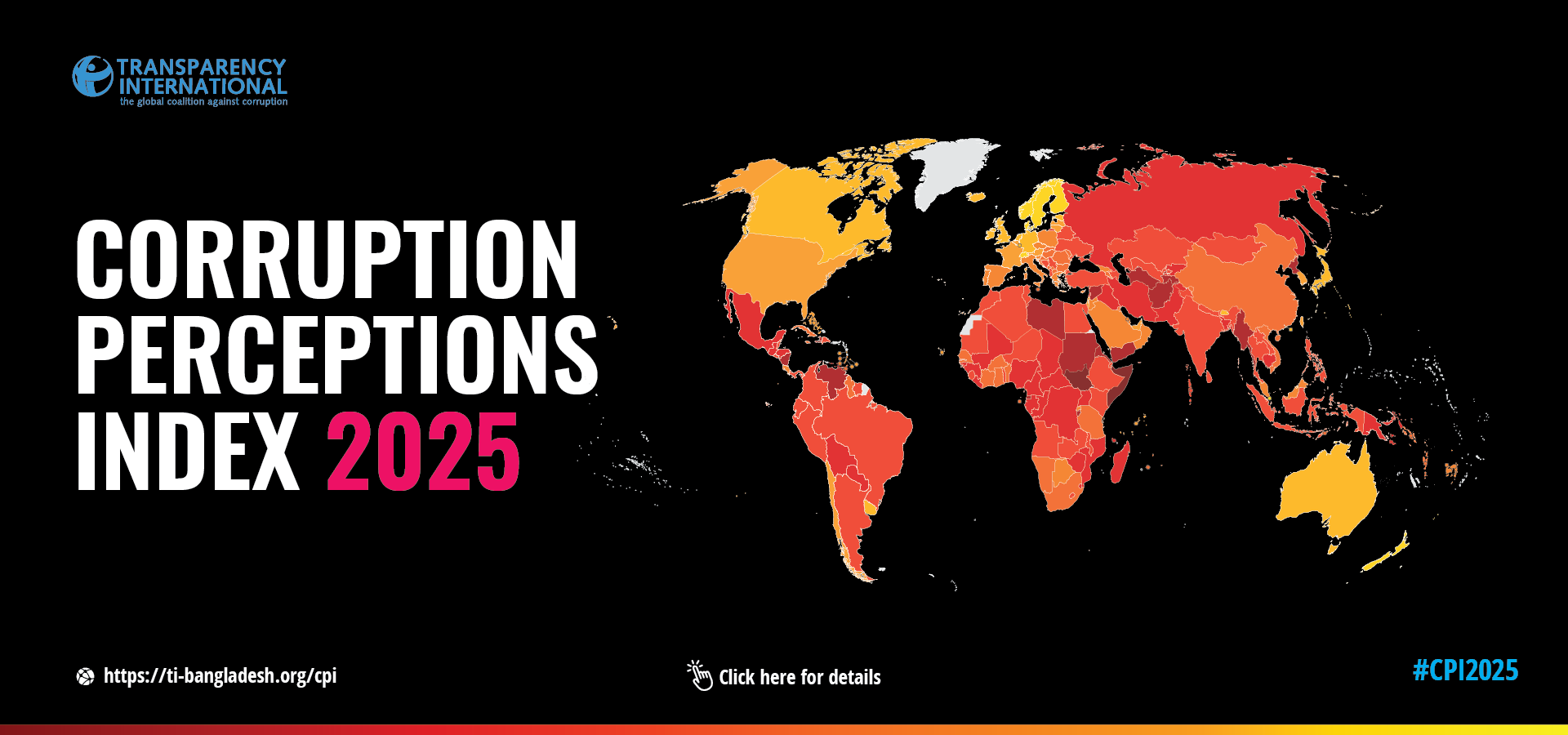
The July Movement raised hopes that Bangladesh had turned a corner on corruption. Sixteen months later, the Corruption Perceptions Index 2025 reveals how much of that promise has been left unredeemed.
There was a moment, not long ago, when Bangladesh felt different. When the authoritarian government fell in the wake of the July Movement, the sense that the country had finally broken free from decades of entrenched kleptocracy was palpable. International observers took note. So, it turns out, did the surveys that feed into the world's most closely watched corruption index.
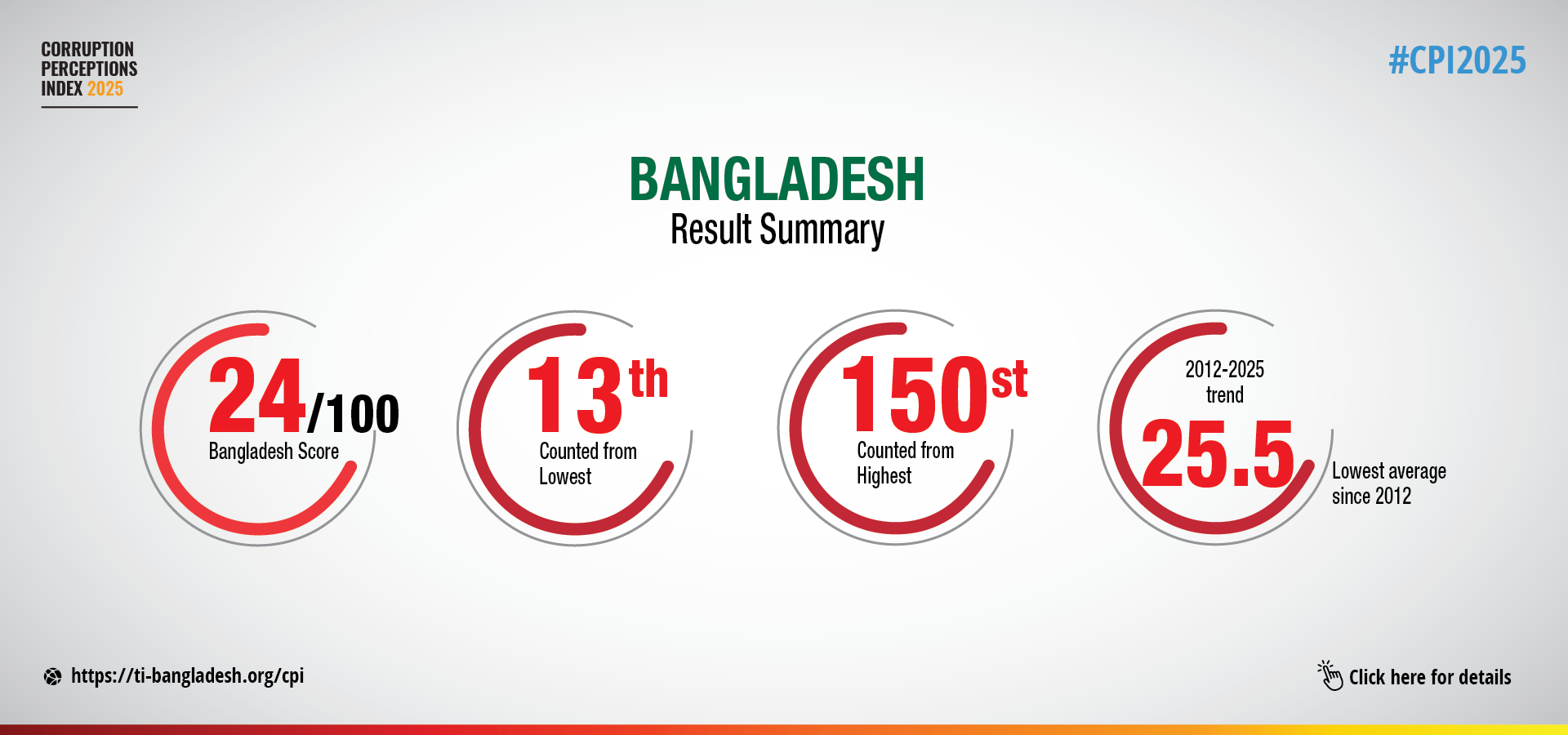
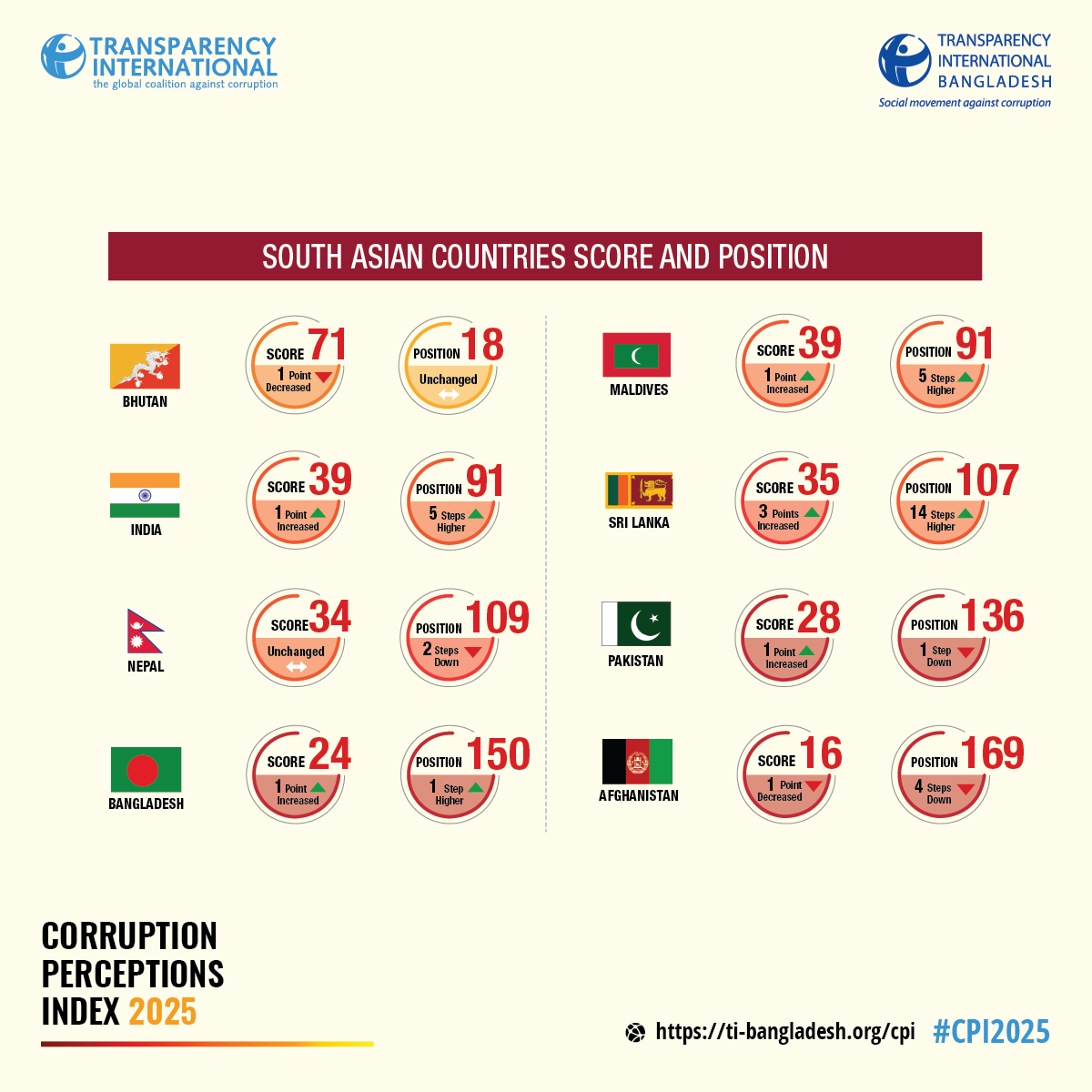
Bangladesh's score in the Corruption Perceptions Index 2025 rose by one point to 24 out of 100. Its ranking, counted from the top, moved up a single place to 150th out of 182 countries. On the surface these are modest gains. But Transparency International Bangladesh, which presented the findings at a press conference in Dhaka on 10 February 2026, was careful not to let the improvement obscure the underlying reality. Counted from the bottom, Bangladesh is the 13th most corrupt country in the world. Its score is the second lowest it has recorded since the current measurement scale was introduced in 2012. And the one-point uptick, TIB's Executive Director Dr. Iftekharuzzaman explained, captures the optimism of a moment that has since given way to disappointment.
"The score reflects the unrealized positive prospects of the July uprising. It does not yet reflect the subsequent reality of the state reform process." — Dr. Iftekharuzzaman, Executive Director, TIB
The CPI is produced by Transparency International's secretariat in Berlin using data drawn from 13 independent international surveys. For Bangladesh, eight sources were used, including assessments by the World Bank, the World Economic Forum, the World Justice Project, the Economist Intelligence Unit, the Bertelsmann Foundation, and the Varieties of Democracy Project. Data for this edition covers the period from November 2023 to September 2025. No nationally generated data, including TIB's own research, enters the calculation. The methodology is designed expressly to ensure international comparability and is developed and verified by independent experts.
Those survey sources captured a country in the immediate aftermath of a political transformation, when expectations for reform were high and the fall of the previous regime was still fresh. What they could not yet fully reflect was what unfolded in the months that followed: the persistence of corrupt practices in political and governance spaces, the interim government's failure to model transparent and accountable conduct, and the stalling of the very reforms that the change of government had promised. TIB describes this gap between expectation and execution as a lost opportunity, a moment when the foundations of a genuinely different kind of governance could have been laid, but were not.
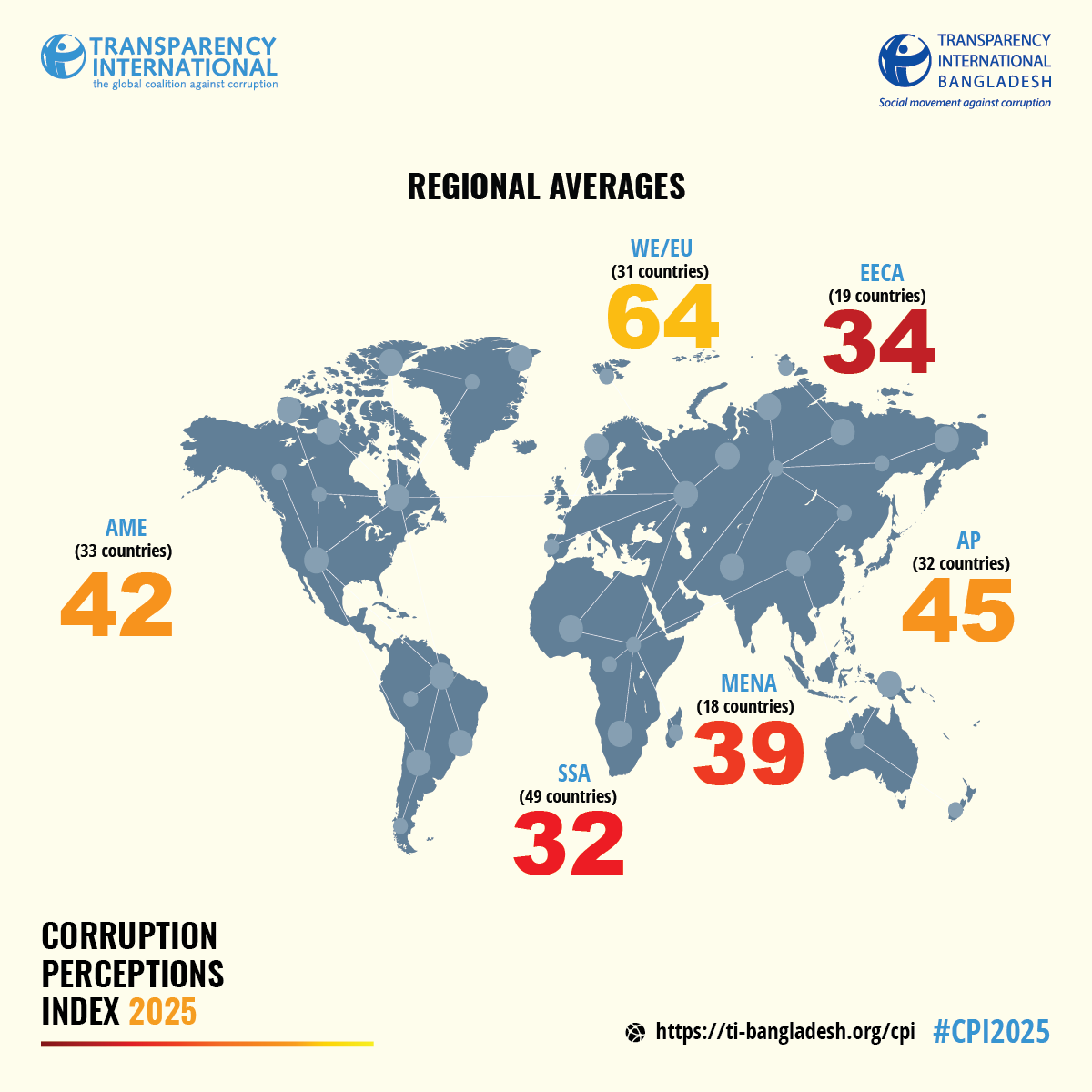
The numbers place Bangladesh's predicament in sharp relief. Its score of 24 sits 18 points below the global average of 42 and 21 points below the Asia-Pacific regional average of 45. It is lower than the average for every world region included in the CPI, including Sub-Saharan Africa, which scores 32. It falls below the average for authoritarian regimes globally, which is 29. And it sits four points below the average for countries classified as having closed civic space, which is 30. Bangladesh, according to the CPI's own analytical framework, belongs to that closed civic space category.
The CPI's comparative analysis of regime type and civic space offers an important lens for interpreting these figures. Countries with functioning democracies and full civic freedoms consistently outperform others on the index. Fully democratic countries average 71. Flawed democracies average 47. Hybrid regimes average 36, and authoritarian states 29. The pattern is clear and consistent: where citizens are free to speak, organize, and hold power to account, corruption is lower. Where that freedom is curtailed, corruption tends to flourish. Bangladesh's placement in the most restricted category is not merely a statistical classification; it reflects a governance environment in which the mechanisms best suited to checking corruption are systematically weak.
In South Asia, Bangladesh ranks second lowest, ahead only of Afghanistan. Sri Lanka was the region's standout performer this year, improving its score by three points and climbing 14 ranking positions. India and the Maldives each rose five positions. Bangladesh's single-step improvement places it at the trailing edge of a region that itself continues to lag behind global averages. With the exception of Bhutan, which scored 71, every South Asian country scored below the global average of 42. The breadth of the challenge across the region offers little comfort to any individual country, but it does underscore that Bangladesh's difficulties are not isolated from a wider regional failure of governance.
Among 182 countries, 68 saw their scores decline in 2025. The global average of 42 is the lowest in over a decade. Bangladesh, at 24, sits 18 points below it.
TIB's analysis identifies a series of specific failures that have contributed to Bangladesh's continued poor standing. There is no strategic anti-corruption reform agenda and no implementation plan behind the reform rhetoric. The state reform process has been fragmented, shaped by ad-hoc decisions, bureaucratic resistance, and a selective approach that picks reforms likely to be politically convenient while sidelining those that would meaningfully constrain powerful actors. The Anti-Corruption Commission, which should be the country's institutional backbone in the fight against graft, has shown what TIB describes as inaction or outright resistance to the recommendations placed before it. The interim government has not set the kind of exemplary standards of transparent, conflict-of-interest-free governance that would signal a genuine shift in political culture.
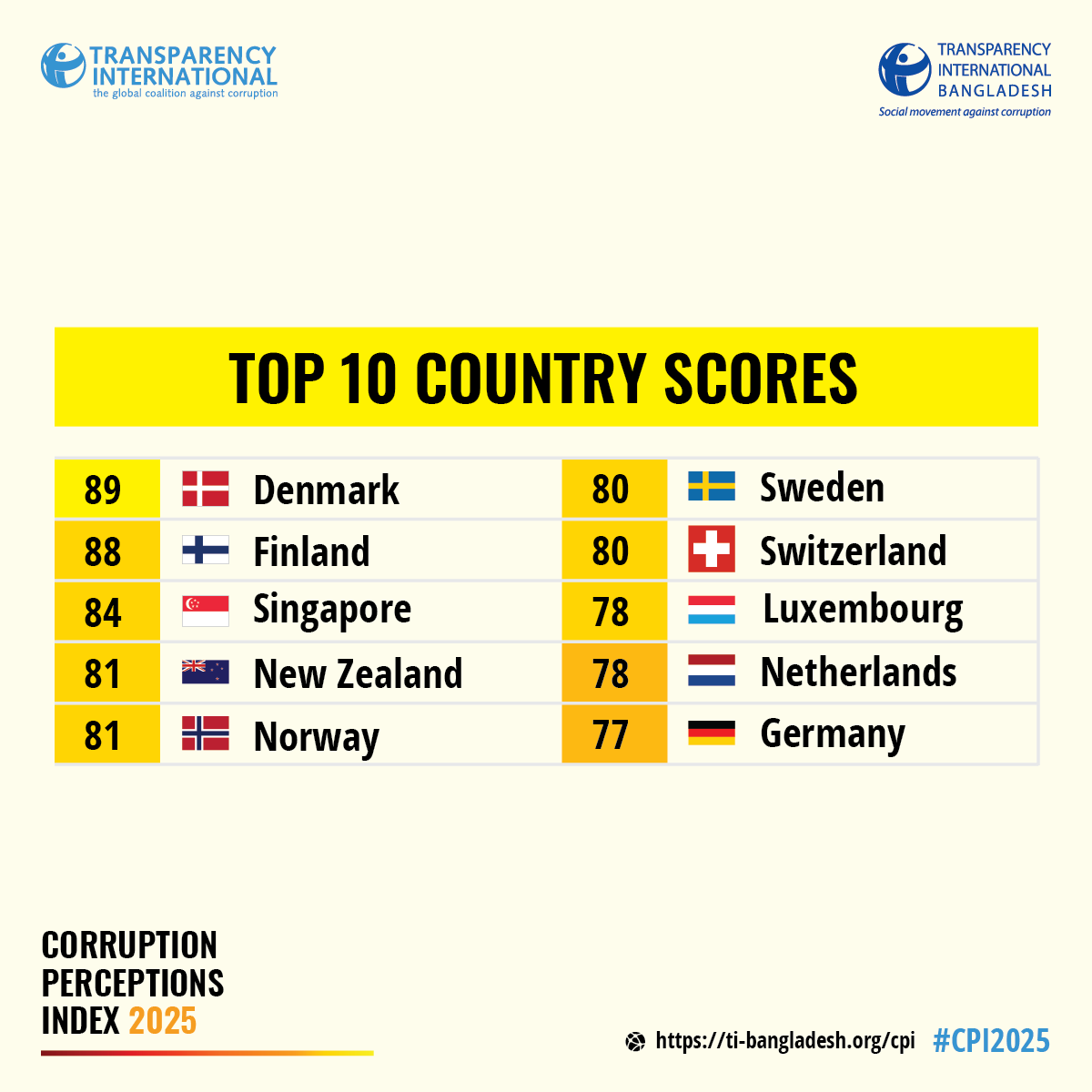
Adding to the concern is the emergence of what observers describe as the "our turn" syndrome. The removal of one set of politically connected actors from positions of privilege has not, in many parts of Bangladesh's national and local governance landscape, led to a cleaner environment. It has instead created openings for a new generation of actors to exploit the same systems for the same ends. Extortion has continued. Money laundering, TIB noted, has not stopped; it has simply found new beneficiaries. The countries that receive the largest flows of illicitly moved Bangladeshi money, including Singapore, Switzerland, Australia, Canada, the United Kingdom, the UAE, and the United States, all rank among the top performers on the CPI. The contrast is a pointed one.
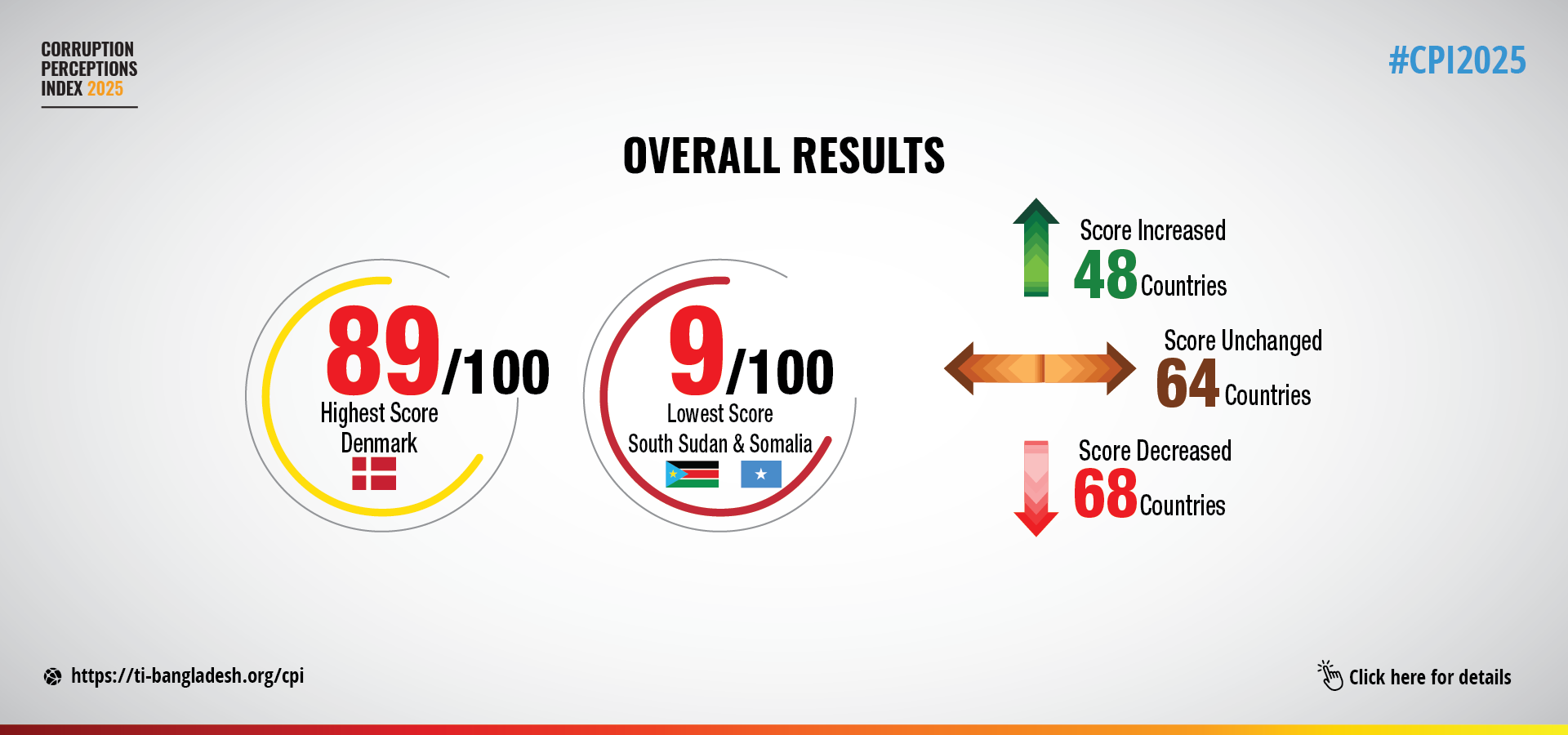
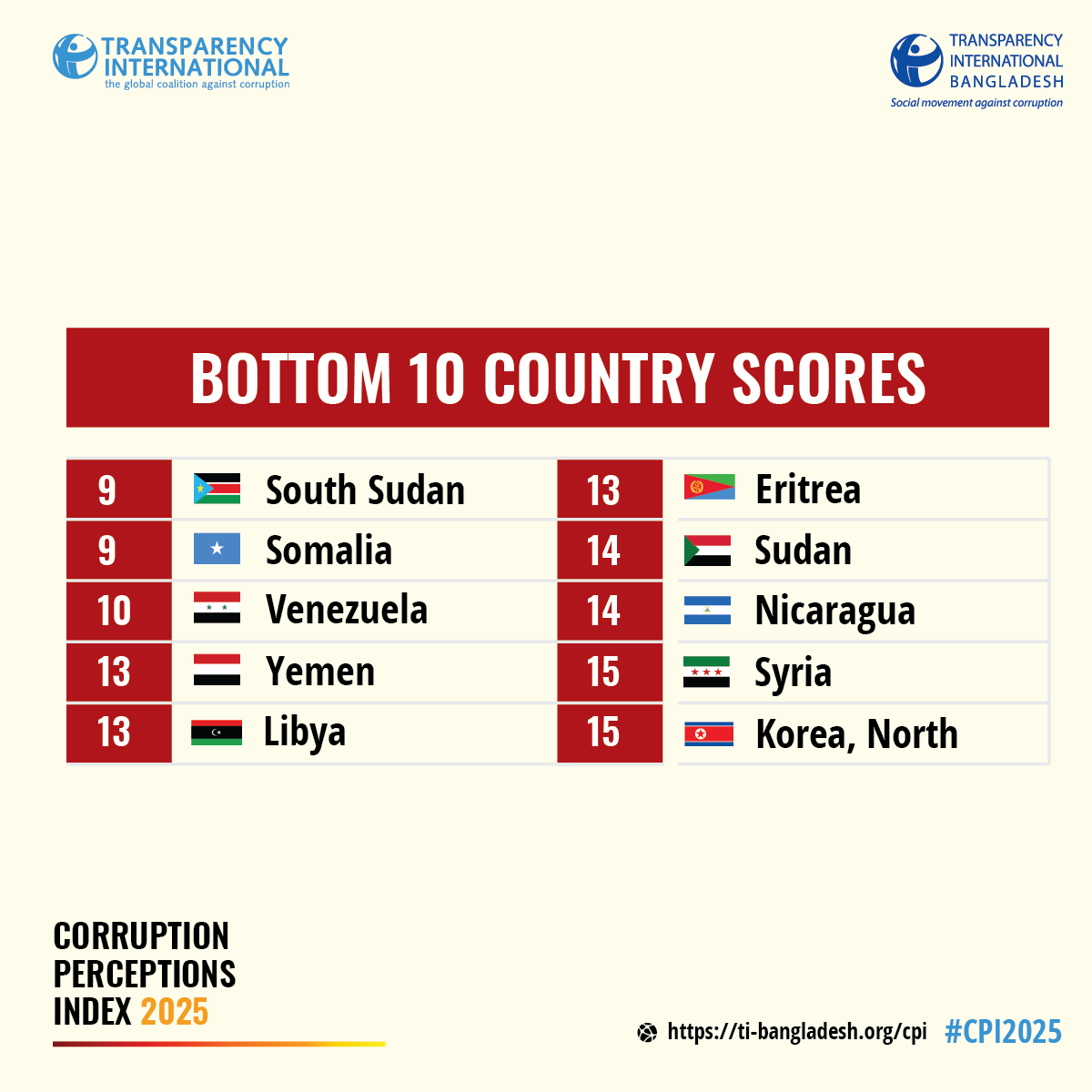
The global picture that surrounds Bangladesh's result is not reassuring either. The 2025 CPI documents a world in which corruption is broadly worsening. The global average score has fallen to its lowest point in more than a decade. Among the 182 countries assessed, 68 saw their scores decline, 48 improved, and 64 were unchanged. Two thirds of countries scored below 50, the threshold for a serious corruption problem. More than half scored below the global average, meaning the majority of the world's population lives under conditions of what the CPI classifies as very serious corruption. The longer trend is worse: since 2012, 50 countries have significantly worsened, while only 21 have significantly improved.
Yet the same data that documents global decline also holds out evidence that progress is possible. Countries including Nepal, Vietnam, Timor-Leste, Ukraine, Angola, and Sri Lanka have all improved their standings from positions once comparable to or lower than Bangladesh's current score. The common threads in those turnarounds have been sustained and comprehensive institutional reform, the end-to-end digitalization of public services to reduce opportunities for bribery and discretionary decision-making, the effective prosecution of high-level corruption in political, governmental, and corporate spheres, and meaningful protection for media and civil society.
TIB has set out what it believes Bangladesh must do to join that group of improvers. It calls for the full implementation of the Anti-Corruption Reform Commission's recommendations, with particular urgency around making the ACC genuinely independent, accountable, and effective. It urges the adoption of a National Anti-Corruption Strategy, Beneficial Ownership Transparency legislation with a public register, Common Reporting Standards to track illicit financial flows, and transparent rules on political and electoral finance. Beyond the institutional framework, it insists that public positions must stop being treated as opportunities for private gain, that all state institutions including the judiciary, bureaucracy, and law enforcement must be depoliticized, and that the freedom of the media and civil society to scrutinize power must be actively protected rather than merely tolerated.
The one-point improvement in Bangladesh's 2025 CPI score is real. It reflects a genuine moment in the country's recent history when the prospect of change seemed credible to the international experts and institutions whose assessments feed into the index. That credibility has since been tested by the events that followed. Whether the score one year from now reflects a recovery of that credibility, or a further erosion of it, will depend on choices that are being made right now, in government offices, in the halls of the Anti-Corruption Commission, in political party structures, and in the courts.
The CPI 2025 full results and Bangladesh country data are available at ti-bangladesh.org/cpi